Choosing tile for a shower is about much more than picking a color you like. The size of the tile can change the entire appearance of the bathroom, affect how much grout is visible, influence the installation process, and determine how easily the finished surface can be maintained.
That is why the question of whether large or small tiles work better deserves more than a simple answer.
Large-format tiles can create a clean, contemporary appearance with fewer visible grout lines. Smaller tiles, including subway and mosaic formats, offer more flexibility with patterns, transitions, niches, and detailed designs. Neither approach automatically works better for every shower.
The right choice depends on the size and shape of the shower, the look you want to achieve, the condition of the walls, your maintenance preferences, and how the different tile formats will work together.
If you are comparing tiles for shower walls, understanding these differences before installation can help you create a bathroom that looks intentional rather than simply following a trend.
Why Tile Size Matters More Than Most Homeowners Expect
Tile size affects the visual rhythm of a shower. A wall covered with 3×6-inch subway tile creates a completely different impression from the same wall covered with 12×24-inch porcelain.
The difference is not only aesthetic.
Tile size also changes the number of grout joints, the amount of cutting required, how the layout interacts with corners and fixtures, and how much precision is needed during installation.
Large-format tile is increasingly used for shower walls because it can produce a more continuous appearance. Current large-format options include formats such as 12×24 and 24×48, while even larger porcelain panels are available for some applications.
Smaller formats remain popular for good reasons. Subway tile, mosaics, and other compact shapes can make complicated layouts easier to manage and provide opportunities to introduce patterns or accent areas.
The most successful bathroom designs usually treat tile size as part of the overall design rather than making the decision in isolation.
Large Tiles for Shower Walls
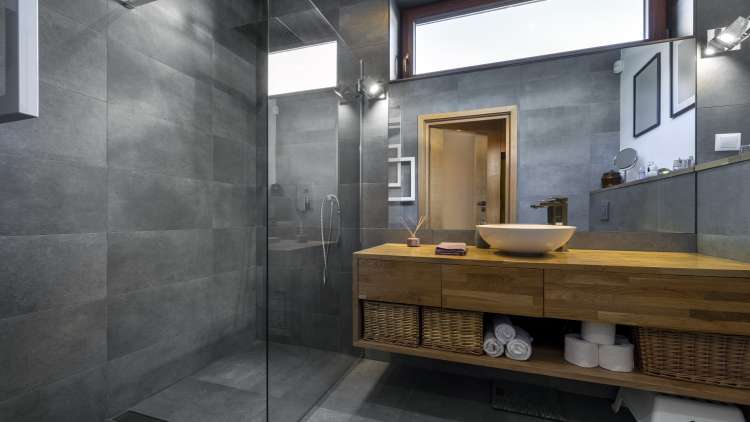
Large-format tile has become a popular choice for contemporary shower designs, particularly when homeowners want fewer visual interruptions across the walls.
A large tile can cover substantially more surface area than a traditional subway tile, creating longer visual lines across the shower.
12×24 Tiles
The 12×24 format is one of the most versatile large-format options for shower walls.
Its rectangular proportions allow it to be installed horizontally or vertically, depending on the proportions of the room.
Installed horizontally, 12×24 tile can emphasize the width of a shower. Installed vertically, it can draw the eye upward and make the walls feel taller.
This flexibility makes it suitable for many different bathroom layouts.
It also provides a useful middle ground. The tiles are substantially larger than traditional subway formats without becoming as demanding to handle as very large pieces.
24×48 Tiles
24×48 tile creates a much more dramatic large-format appearance.
With fewer individual pieces covering the wall, the finished surface can have a more continuous visual flow. Large rectangular porcelain tiles are available in this format, including stone- and terrazzo-look designs.
This format can work particularly well in larger walk-in showers where there is enough uninterrupted wall space for the scale of the tile to make sense.
However, bigger does not automatically mean easier.
Large tiles require careful substrate preparation, accurate layout, appropriate mortar coverage, and experienced handling. Manufacturer installation guidance specifically emphasizes the importance of a properly prepared and level substrate when working with large-format tile.
When Large-Format Tile Makes Sense
Large tile can be a strong choice when you want a modern, streamlined appearance and relatively few grout lines.
It can also help create visual continuity when the same or coordinating tile is carried from one shower wall to another.
Large formats are especially interesting for walk-in showers, spacious bathrooms, and designs featuring stone-look porcelain. They can allow the natural-looking variation and veining of the tile to become the main visual feature rather than breaking the design into many small sections.
But the wall itself matters.
Large tile does not hide an uneven substrate. In fact, its size can make imperfections more noticeable and installation more demanding. Proper preparation is therefore an important part of the design decision, not an afterthought.
Small Tiles for Shower Walls
Small tiles give homeowners a very different set of design possibilities.
Instead of creating large uninterrupted surfaces, they introduce more grout lines and a stronger pattern. That can be exactly what a bathroom needs when the goal is to add character or visual detail.
Subway Tile
Subway tile remains one of the most adaptable choices for shower walls.
Classic 3×6-inch subway tile creates a familiar look, while longer formats such as 4×12 can produce a more contemporary interpretation.
The installation pattern can also change the character of the room.
A traditional running bond gives the wall a familiar horizontal rhythm. A vertical arrangement can make the shower feel taller, while stacked layouts can create a cleaner, more contemporary appearance.
Because subway tile is relatively compact, it also provides flexibility around corners, niches, plumbing fixtures, and other details.
Mosaic Tile
Mosaic tile is another useful option when you want a more detailed surface.
Mosaics are available in many shapes and sizes, including small squares, rectangles, hexagons, and decorative patterns. They can be used as an accent or combined with larger wall tile.
Their small individual pieces also make them useful when working around areas where full-size tiles would require awkward cuts.
Many mosaics come mounted on mesh sheets, which can simplify handling and help maintain a consistent pattern during installation. However, careful alignment is still important because even small shifts can become noticeable when multiple sheets meet.
Mosaic tile does not have to cover the entire shower.
A narrow accent band, shower niche, or feature wall can introduce a smaller scale without overwhelming the rest of the bathroom.
Smaller Formats in Niches and Accent Areas
One of the most effective ways to combine tile sizes is to use large-format tile across the main walls and a smaller tile in a carefully selected area.
A shower niche is a natural location for this approach.
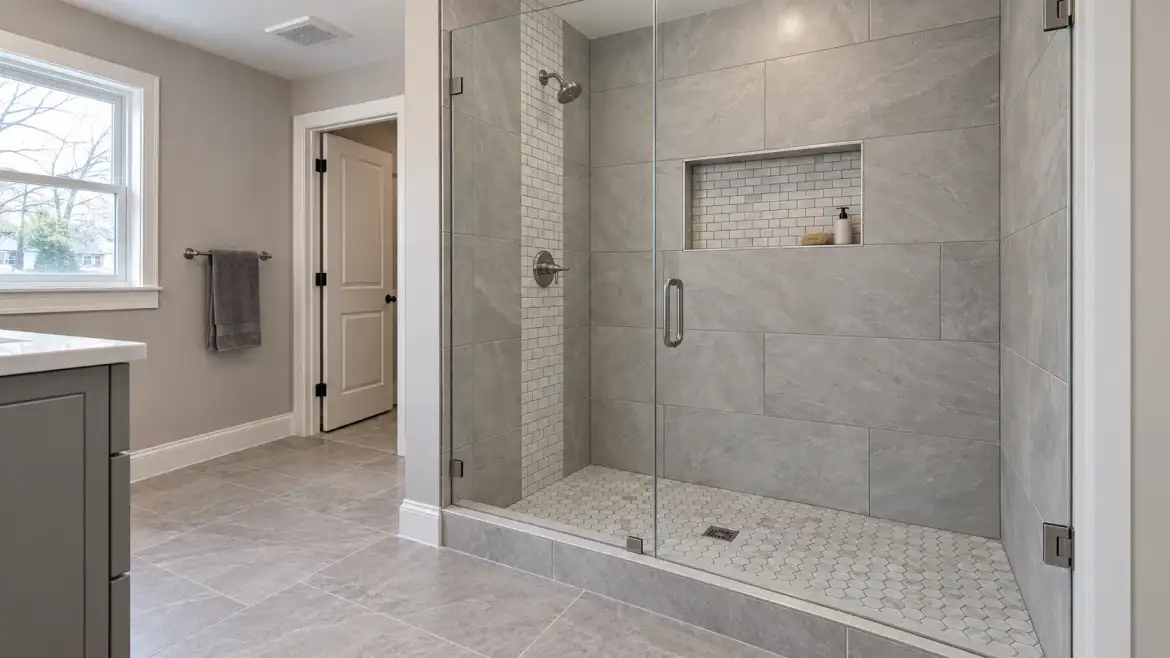
For example, large stone-look porcelain walls can be paired with a small mosaic inside the niche. The contrast immediately defines the storage area without requiring another material throughout the shower.
The same concept can work around a bench or on a selected accent wall.
Using different scales gives the eye something to notice while allowing the larger tile to maintain the primary visual structure.
Large vs. Small Tiles for Cleaning and Maintenance
One of the practical differences between large and small tiles is the amount of grout visible on the finished surface.
A large-format tile generally means fewer grout joints across the same wall area. Manufacturers also highlight reduced grout lines as one of the design and maintenance advantages of large-format wall applications.
That can make the surface feel cleaner and more continuous.
It can also mean fewer individual grout lines to scrub.
Small tile creates more joints, which increases the amount of grout visible throughout the shower. That is not necessarily a problem, but it should be considered when maintenance is part of your decision.
The actual maintenance requirements also depend on the tile material, grout selected, surface finish, ventilation, cleaning routine, and how the shower is constructed.
In other words, choosing large tile is not a substitute for proper bathroom maintenance.
How Tile Size Changes the Look of a Small Shower
Small bathrooms are where tile size becomes especially interesting.
A common assumption is that a small shower should always use small tile. In reality, large tile can sometimes make a compact shower feel visually calmer because fewer grout lines interrupt the walls.
A 12×24 tile installed horizontally can emphasize width, while the same format installed vertically can emphasize height.
A lighter tile with a grout color that blends closely with the tile can further reduce visual interruptions.
That does not mean large tile is always the right answer for a small shower.
A small shower with multiple corners, curves, niches, or architectural details may be easier to lay out with smaller tile. Large pieces can require more cutting and may create narrow slivers of tile at the edges if the layout is not planned carefully.
The goal should be a balanced layout, not simply the largest possible tile.
Do Large Tiles Really Mean Less Grout?
Yes, generally, but there is an important distinction.
A larger tile covers more surface area, so fewer individual tiles are needed to cover the same wall. That usually results in fewer grout joints.
For example, a wall covered in 24×48 tiles will have dramatically fewer joints than the same wall covered with 3×6 subway tiles.
However, large-format tile still requires properly sized grout joints. The joints cannot simply be eliminated because the tile is large.
Installation guidance for large-format tile emphasizes that grout joints allow for movement, dimensional variation, and other factors that need to be accommodated during installation. Recommended joint sizes can vary depending on the tile and installation conditions, so the tile manufacturer’s instructions and applicable standards should be followed.
This is one reason professional planning matters.
The objective is not to use the smallest possible grout line. It is to create an appropriate, consistent installation that works with the tile.
How Shower Size Should Influence Your Tile Choice
There is no universal tile size that works for every shower.
The dimensions and shape of the space should influence the decision.
Small Showers
For a compact shower, consider how the tile layout will interact with every wall, corner, fixture, and niche.
A 12×24 tile can create a relatively clean appearance, especially when the layout minimizes awkward cuts.
Smaller subway tile can also work beautifully, particularly when the goal is to introduce texture or a classic pattern.
Mosaic can be particularly useful for accent sections and detailed areas.
Standard Tub and Shower Combinations
Tub-and-shower combinations offer a lot of flexibility.
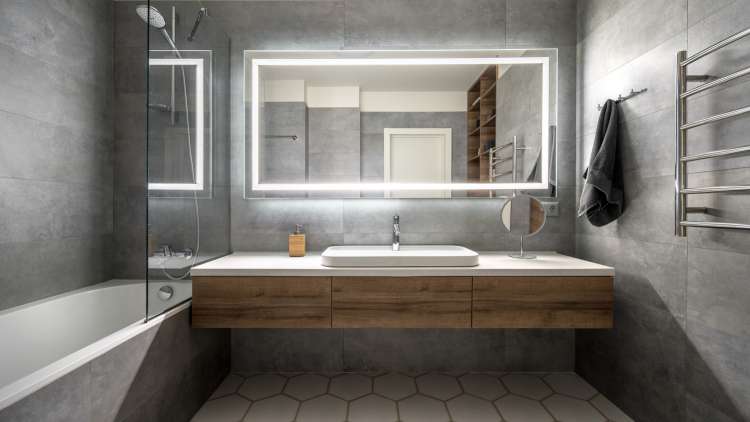
Because the wall area is typically broader and more rectangular, 12×24 tile, subway tile, and medium-format rectangular tile can all work well.
A consistent wall tile can create a simple backdrop, while a smaller accent tile can be introduced around the tub wall or niche.
The proportions of the tile should complement the proportions of the room rather than competing with them.
Large Walk-In Showers
Large walk-in showers can accommodate larger tile formats particularly well.
A 24×48 format may create an impressive uninterrupted appearance across broad walls, especially when the tile has subtle stone-look veining.
Large showers also provide more room to incorporate a combination of scales without making the design feel crowded.
For example, large-format porcelain can cover the primary walls while a smaller mosaic defines the niche and shower floor.
Using different tile scales is a common way to establish visual balance between shower walls and the floor.
Can You Mix Large and Small Tiles on Shower Walls?
Absolutely.
In many cases, mixing tile sizes produces a more intentional design than using one format everywhere.
The key is to give each size a purpose.
Large-format tile can establish the main background. Smaller tile can then highlight a niche, create an accent strip, or define another architectural feature.
The materials do not necessarily need to be identical.
A large marble-look porcelain tile can be paired with a coordinating mosaic. A neutral large-format wall can be combined with a geometric accent. Even two different shapes of the same color can create contrast through scale.
What matters is that the relationship between the materials feels deliberate.
One useful approach is to keep the color palette relatively controlled while allowing the tile sizes and patterns to provide the visual variation.
This prevents the shower from becoming a collection of unrelated surfaces.
Choosing the Right Grout for Different Tile Sizes
Grout is often treated as a minor finishing detail, but it can dramatically affect how tile is perceived.
With small tiles, grout can become a significant part of the visual pattern because there are more joints.
A contrasting grout can emphasize the individual shape of subway or mosaic tile. A grout color that closely matches the tile can create a quieter appearance.
With large-format tile, matching grout can help reinforce the continuous look that makes larger tile appealing in the first place.
That means grout color should be considered at the same time as tile size rather than selected after the tile has already been installed.
The width and type of grout joint also need to be appropriate for the specific tile and installation. Large-format installation requires particular attention to grout joint sizing and substrate conditions.
Common Mistakes When Choosing Shower Tile Size
One of the most common mistakes is choosing tile based entirely on a showroom display.
A tile can look fantastic on a large display wall and feel completely different once installed inside a compact shower.
Scale matters.
Another mistake is ignoring the layout until after the tile has been purchased. The installer needs to consider where full tiles will fall, how corners will line up, where niches will be positioned, and how cuts will look around fixtures.
Choosing an oversized tile for a highly detailed shower can also create unnecessary installation challenges.
On the other hand, automatically choosing tiny tile for every small shower can produce more grout lines than necessary and may create a busier appearance than the homeowner intended.
Another issue is assuming that fewer grout lines eliminate the need for proper waterproofing and installation practices.
They do not.
The tile is the visible finish, but a successful shower depends on the complete assembly behind and beneath that finish. Tile manufacturers’ installation instructions should be followed for the specific product and application.
Finally, avoid choosing wall tile without considering the shower floor.
The floor has different functional requirements because it must accommodate drainage and provide an appropriate walking surface. Smaller mosaics are commonly used on shower floors because their smaller pieces can better follow the slope toward the drain.
So, Which Size Is Right for Your Shower?
There is no single winner between large and small tiles.
Large tiles can create a clean, spacious appearance with fewer grout lines and strong visual continuity. They can be particularly effective in modern bathrooms and larger walk-in showers.
Small tiles provide greater pattern flexibility and can work especially well around niches, corners, detailed layouts, and accent areas. Subway tile can create a timeless look, while mosaics introduce additional texture and visual interest.
For many bathrooms, the most effective solution is not choosing one size at all.
A large-format tile can establish the main shower walls, while a smaller mosaic can add definition to the niche or another focal point. This combination creates contrast without requiring the entire shower to compete for attention.
The most important step is to consider the complete installation before choosing the tile. Measure the shower, study the wall proportions, account for niches and fixtures, think about grout lines, and determine how the wall tile will relate to the floor and the rest of the bathroom.
When those decisions are made together, tiles for shower walls become more than a surface finish. They become part of the architecture of the room, influencing how large the shower feels, how easy it is to maintain, and how cohesive the entire bathroom looks.
A well-planned tile installation should not just make a shower look good on the day it is finished. It should make sense for the space, the way the bathroom is used, and the design you want to live with for years.